Showing posts with label shimano. Show all posts

Training for a Triathlon

As we continue through the 2nd decade of the 21st century, some Schwinn enthusiast may have decided to achieve a greater advanced level of endurance by participating in a triathlon. A triathlon is a multi-sport endurance event consisting of swimming, cycling, and running in immediate succession over various distances. Triathletes compete for the fastest overall course completion time, including timed transitions between the individual swim, bike, and run components.


According to the International Triathlon Union and the USA Triathlon, the main international race distances are Sprint distance (750 m swim, 20 km bike, 5 km run), Intermediate distance, commonly referred to as Olympic distance (1.5 km swim, 40 km ride, 10 km run), Long Course (1.9 km swim, 90 km ride, 21.1 km run), such as the Half Ironman, and Ultra Distance (3.8 km swim, 180 km ride, and a marathon: 42.2 km run); the most popular branded Ultra Distance is the Ironman triathlon.

Bike Shoes And Clipless Pedals-Are They For You?

Shoes are the power transmitting devices on your bike. Cycling shoes are stiff so that the feet are protected from the strain of pedaling. This stiffness also allows more of your power to be transmitted to the rear wheel. Whatever shoes you decide to go for, be sure to have compatible pedals. Several systems are available that allow cycling shoes to more efficiently connect to the pedal.

Are Bike Shoes For Me?


You can ride a bike in just about any shoes, and that may be fine for someone that rides only minimal. But anyone who rides distance or for competition can benefit from shoes specifically designed for bicycling. The more comfortable your feet are while you ride can only benefit your over-all riding experience. Shoes with cleats referred to as “clipless” provide continuous power to the driving wheel.

Compared to typical athletic shoes, cycling shoes are designed with stiffer soles to provide more efficient energy transfer to your rear wheel as you pedal. These stiff soles also protect your feet while riding and support the full length of each foot to reduce cramping and fatigue. The uppers are also relatively rigid for extra support.

Cycling shoes can be “clipless” or not. The clipless shoe pedal combination offers unmatched control and greater transfer of power to the rear wheel. If you are a casual rider or prefer shoes without cleats, the typical platform pedals are all you need. Another choice is the combination clipless/platform pedals that gives you the option of clipless or platform.

Choosing Bike Shoes


While deciding on the right bike shoes for you, keep in mind proper shoe/pedal compatibility. There are many different types and styles of cycling shoes designed for all categories of biking and rider preference.


Which Pedal system is Best?


Each type has pros and cons. There is no "best" system - simply one which works best for you. Take some time to decide the ones that are right for you.


 Protruding Cleats
Can Make
Walking Difficult.
Out-soles are available in smooth and lugged patterns with rigidity ranging from stiff to very stiff. Casual riders and commuters do fine with basic rubber soles while mountain bikers require aggressively lugged soles for maximum traction while walking. These soles offer grip on rocky or unstable surfaces. Road cyclists typically prefer shoes with smooth soles for minimum weight and wind resistance and some offer carbon-fiber soles to maximize power transfer. Clipless style out-soles come with 2 hole(SPD-style), 3 hole(Look-style) and 4 hole(Time-style) with cleats protruding from or recessed into the sole.


Drivetrain: Shimano vs Sram


If you’re planning on upgrading your current ride with a new drive-train, should you go with Shimano or Sram components? Maybe you’re going for a custom build or getting a new bike altogether. I think most would agree that Shimano and Sram are the top contenders to consider. But which one is better?

Shimano Bicycle Components

Shimano holds nearly 90% of the entire world’s cycling component market and 97%+ of the worlds OEM market (not sure how current that is).  They turn over US $1 billion in bike components.  How could they not be good with numbers like that?

Starting in the 1960’s with a humble 3-speed hub, Shimano now sets industry standards for bicycle components and is everywhere in all aspects of cycling. By strategizing with elite manufacturers, Shimano remains in a constant state of progress, developing core components for everyday commuting. Through advocacy programs, commitment to environmental protection, and responsible business practices, Shimano contributes not only to cycling, but to the community as well.

SRAM Bicycle Components

SRAM is not as well known, but is a strong competitor and gaining unbelievable ground.  It has great ergonomics and a shifting mechanism that works great. Sram is aggressively and successfully increasing in the market share.

SRAM Corporation began with the goal of creating the absolute best drive-train system and has changed the cycling world forever with the introduction of Grip Shift. They continue to seek and introduce new technology and engineering advancements, as they compulsively refine and redefine the pinnacle of the ultimate ride.  And to genuine cycling enthusiasts, there is nothing more gratifying then achieving the ultimate ride. And Sram just keeps making it better.

Is One Drive-train Better Than The Other

Both SRAM and Shimano drivetrain systems work quite well. It is clear that you can adjust both systems to work reliably and consistently. Both systems also have comparable product levels with X-0, X-9, X-7 and so forth for SRAM and XTR, XT, LX and on down for Shimano.

Now, when you get right down to it, one seems no better than the other. Maybe the question should be, which drive-train is better for you? I wouldn’t let the shifter/drive-train question decide what bike to get unless you prefer the way one feels over the other. Either way, you pick a good quality product. How can you go wrong?

How many colors made Up The Schwinn Krate Series?

The popular Schwinn Krate bikes were produced from 1968 until 1972. Originally, the Krate bikes were offered in 6 colors. The first three colors were introduced in 1968. They were the Orange Krate, the Apple Krate (Red), and the Lemon Peeler (Yellow). These three continued to be available for all five model years. The Pea Picker (Green) was introduced in 1969 and continued for all remaining model years. The Cotton Picker (White) had a 2 year run in 1970 and 1971. The rarest of them all was the Grey Ghost which was produced only in 1971. Only 6 colors made up the Original Krate collection.

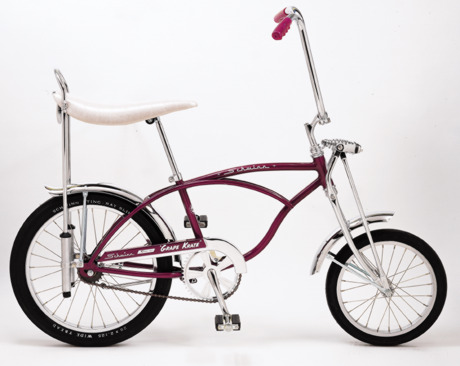
In 1999 Schwinn introduced their reproduction Krates which ran through 2006. These Krates were pretty much true to original specs except the popular stick-shift was excluded and the five speed Shimano shifter was a more efficient updated version. Anyway, back to the color issue. In addition to reproducing the original 6 model Krates, they added another model which Schwinn never formerly produced, the Grape Krate (purple). So all in all there are 7 colors that make up the complete existing collection of Schwinn Krate Bikes.


For better than original quality restoration-Visit Here if interested in Schwinn Krate or any other Bicycle Renovation and Restoring.